

Locust Project presents the 2026 WeaveMaker Summer Residency, featuring Roxana Barba, Loni Johnson and Oscar Rieveling. In keeping with Locust Projects’ mission to support artists with the opportunities to develop ambitious new works, the residency offers space and focus to deepen their practice.
Roxana Barba is a Miami-based interdisciplinary artist whose practice moves between performance, sculpture, sound, and installation. During her residency at Locust Projects, she has been developing Constructs, a durational site-specific performance and installation she is planning to present at Lot 11, the skatepark beneath I-95 in downtown Miami, tentatively set for Fall 2026.
Constructs explores construction and deconstruction, resilience, memory, and the transformations that cities and people go through. Barba is thinking expansively about the systems we are all part of, the rapid changes brought on by technological shifts and structures of power, and at a more fundamental level, about why we build at all: not only to inhabit spaces, but to feel safe, connected, and in some sense whole. Lot 11 speaks directly to this with its concrete roughness, the falls and recoveries of its skaters, and its proximity to Overtown, a community whose heart was fractured by the construction of I-95, give the work its historical and emotional grounding. Cymbals have emerged as a possible sonic and symbolic element, connection to Overtown’s jazz history as one of many remnants woven into the piece.
The studio at Locust Projects has become a testing ground for the sculptural elements Roxana is developing. Materials pulled together, evoking an echo of Lot 11 itself: sharp angular steel forms with triangular arrow-like profiles sit alongside strips of expanded metal mesh, rough concrete fragments, and polished aluminium tubes, handmade ceramic tiles, a curved plywood form raised on concrete blocks, and repurposed bicycle frames, seen from Barba’s window sitting outside, imagined as four-wheeled vehicles carrying dancers in states of imbalance. These modular sculptures are being conceived to hold meaning both independently and in relation to one another, and could potentially exist beyond Lot 11. Photos of Lot 11 and a new visualized concept of a sculptural piece made of large metal structures and cymbals are laid out next to one another, helping Roxana to continue the development of Constructs.
Sound is integral to the piece. Barba plans to record and layer audio live during the performance, creating a dissonant, accumulating sonic environment. Cymbals, chosen in part for their resonance with Overtown’s jazz history, join contact microphones, metal scraps, and the ambient noise of the site itself. The experience she is building is sensorial and immersive. Something seen and heard simultaneously, where the gap between those two registers is part of the work.
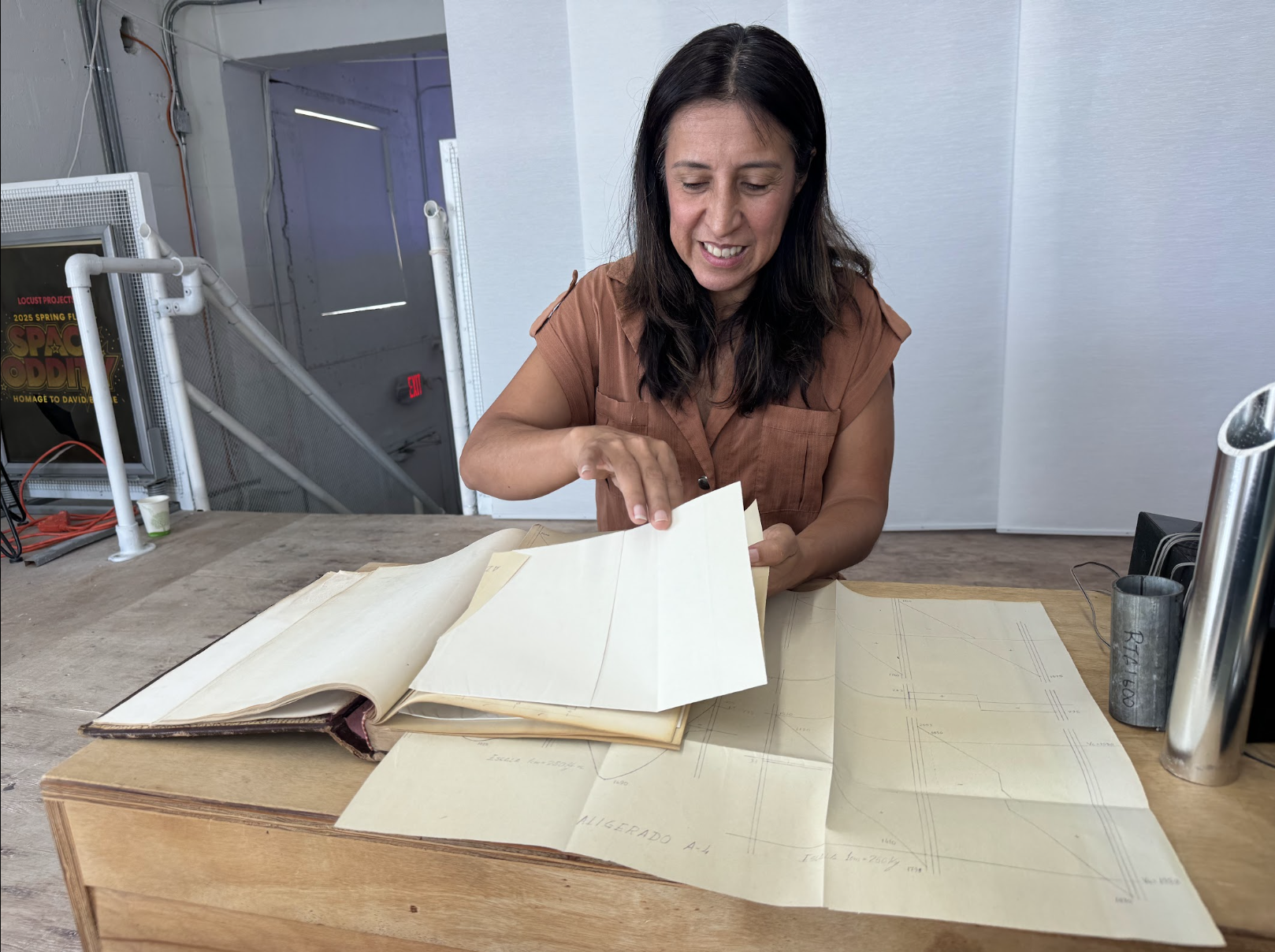
Running beneath the project is a more personal thread: her father’s 1963 civil engineering thesis, its pages filled with handwritten formulas and hand drawn blueprints. Growing up watching the second floor of her family home being built slowly over years, Barba absorbed construction as lived experience and patient hope. She is exploring the possibility of projecting his blueprints onto the wall of the installation through a vintage overhead projector, entering his world rather than illustrating it, and placing that intimate archive alongside the rapid transformations reshaping cities today.
Barba’s process has always been collaborative, though she typically spends a long time working alone before bringing others in. For Constructs she is hoping to work with dancers, musicians, skateboarders and two visual artists, building the work together through trial and error. The residency has given her the space to think, experiment, and begin testing the work’s physical vocabulary, using Locust’s outdoor spaces to rehearse movement and try things out. Being surrounded by other artists working on their projects at Locust, she says, has been quietly sustaining.
Loni Johnson is a Miami-born multi-disciplinary artist whose practice moves through ritual, assemblage, and ancestral memory to create healing spaces for Black women and their communities. Her work during the residency has been oriented toward her forthcoming inclusion in Holding a Bright, Untroubled Sky, a group exhibition at the University of North Carolina Chapel Hill curated by Amy Hale, a curator and writer for Tate Publishing.
The exhibition brings together artists whose practices engage magic and mysticism, a territory Johnson has long inhabited. It marks her third university exhibition, a milestone she frames in terms of access: who gets to see the work, who it reaches, and what community connections it opens.
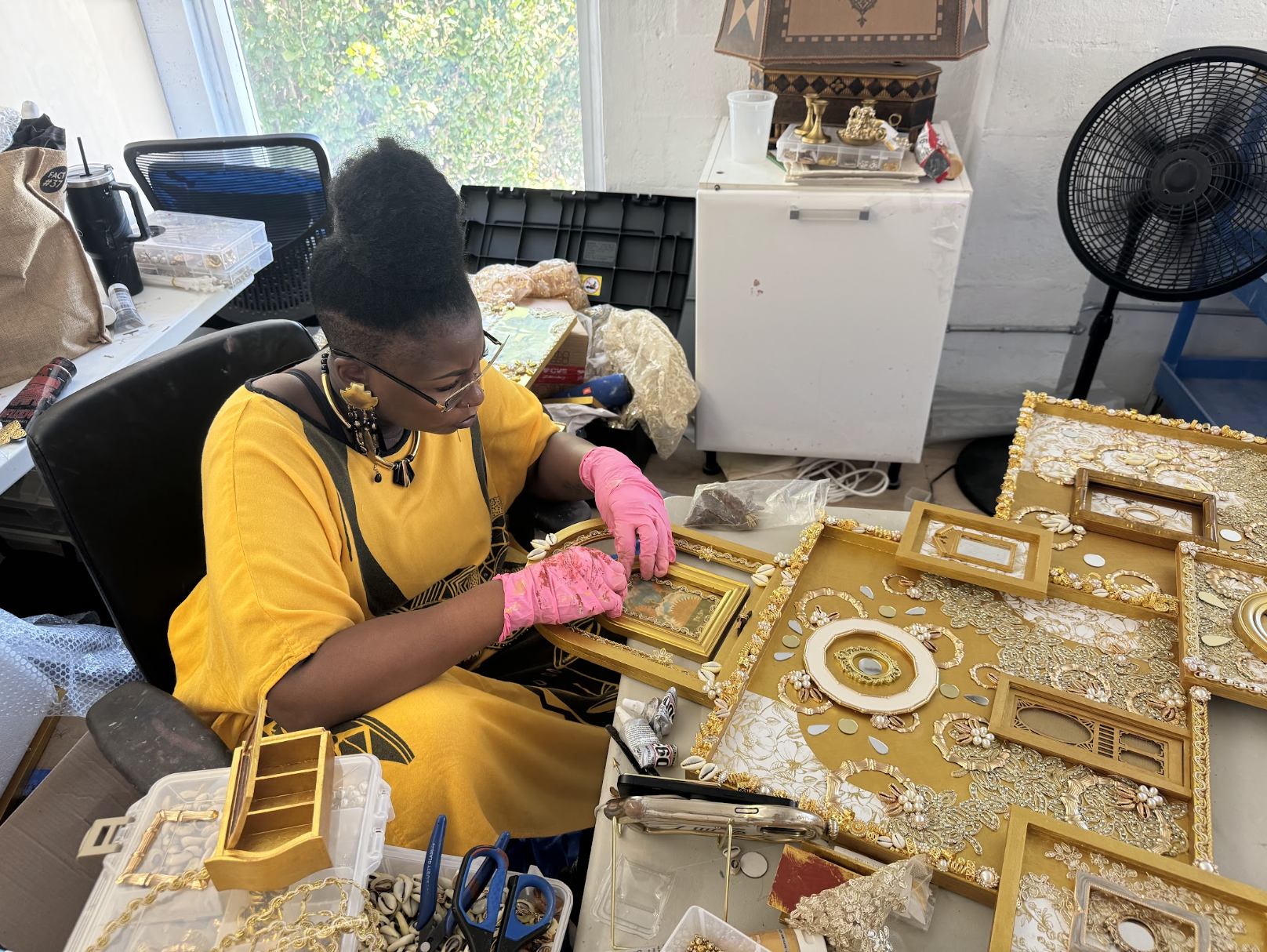
The new sculptural pieces Johnson has developed at Locust Projects expand her established iconography in deliberate ways. Known for assemblages that incorporate gold, mirrors, jewelry components, and collaged family photographs into shrine-like structures, Johnson has begun introducing legumes: black eyed peas, red beans, navy beans, as central material and symbolic elements. Staples of African American tables and spiritual tradition, these objects carry layered meaning: nourishment, good fortune, ancestral continuity. Eaten on New Year's Day as symbols of luck and abundance, they arrive in Johnson's work as objects that hold history in their shells. The freestanding pod sculptures she has been developing, forms she describes as dreamed before they were made, extend this language into three-dimensional space, evoking both organic growth and the domed geometries of shrines across cultures.
Johnson's process is resolutely intuitive and handmade. She does not plan the placement of each element in advance, but responds to the materials, to the images, to what the work asks of her. The studio at Locust Projects is essential to this: a space apart from the demands of caregiving and domestic life where she can focus on her art practice. Her work has long drawn from her personal archive and family history, but Loni describes a shift in intention from work made to heal herself, toward work made to heal and connect others.
Oscar Rieveling is a Miami-based conceptual artist whose interdisciplinary practice explored self-identity, cultural memory, Mexican heritage, and the ways we communicate love and affect. During his residency at Locust Projects, he has been developing two bodies of work: Auto-Mariarchi, his ongoing performing series, and La Diosa de Oro (The Golden Goddess), a newer and evolving interdisciplinary project.
Auto-Mariachi invites mariachi musicians to serenade one another, creating a closed circle of giving and receiving that asks a simple but profound question: who serenades the serenaders? First conceived in 2018 after a vivid vision that came to Oscar while sitting silently in the rain, the project has grown steadily since its first presentation at Redland Market Village, supported by Booklegger’s Library. Since then, Oscar has done a total of five Auto-Mariarchi performances, the latest one being in Mexico City, Mexico during the Mexico City Art Week with the support of Oolite Arts. This October, it will have its first European presentation in Venice, Italy, where a group of musicians, traveling from Milan, representing Peru, Spain, Venezuela and the US among other countries, will perform on the waterways during the Venice Biennale alongside the Commissioner group from Miami. For Rieveling, the connection between the waterways of Mexico City, Miami and Venice felt like a natural through line. The residency has also pushed the project into the new sculptural territory: working with the idea of the architectural folly, a construction that suggests something grander without being structural. Oscar is exploring how to evoke the spaces of the serenade, a balcony, a courtyard, an interior without the physical presence of musicians.
La Diosa de Oro has been in development since 2018, when another vision, this one arriving during breathwork meditation session, showed Oscar a performer on a Miami beachfront invoking the spirit of Conchita Cíntron, a celebrated female bullfighter of the 1930s and 40s. The image of Cíntron, whose presence was said to elicit an almost uncontrollable emotional response in audiences, had stayed with Rieveling since he first encountered it. In the work he is developing, the traditional muleta and the cloth a bullfighter wields, becomes instead a way of dancing with the shoreline, moving with the waves rather than dominating a bull. The work asks what it means to seek control over natural forces, and imagines a different kind of relationship with the environment. Still in its early stages, Rieveling is developing the technical skills the project requires, recently completing a 16mm film workshop, and beginning to connect with dancers and collaborators. He sees the project as a multi-year endeavor, with the video installation as its eventual form.
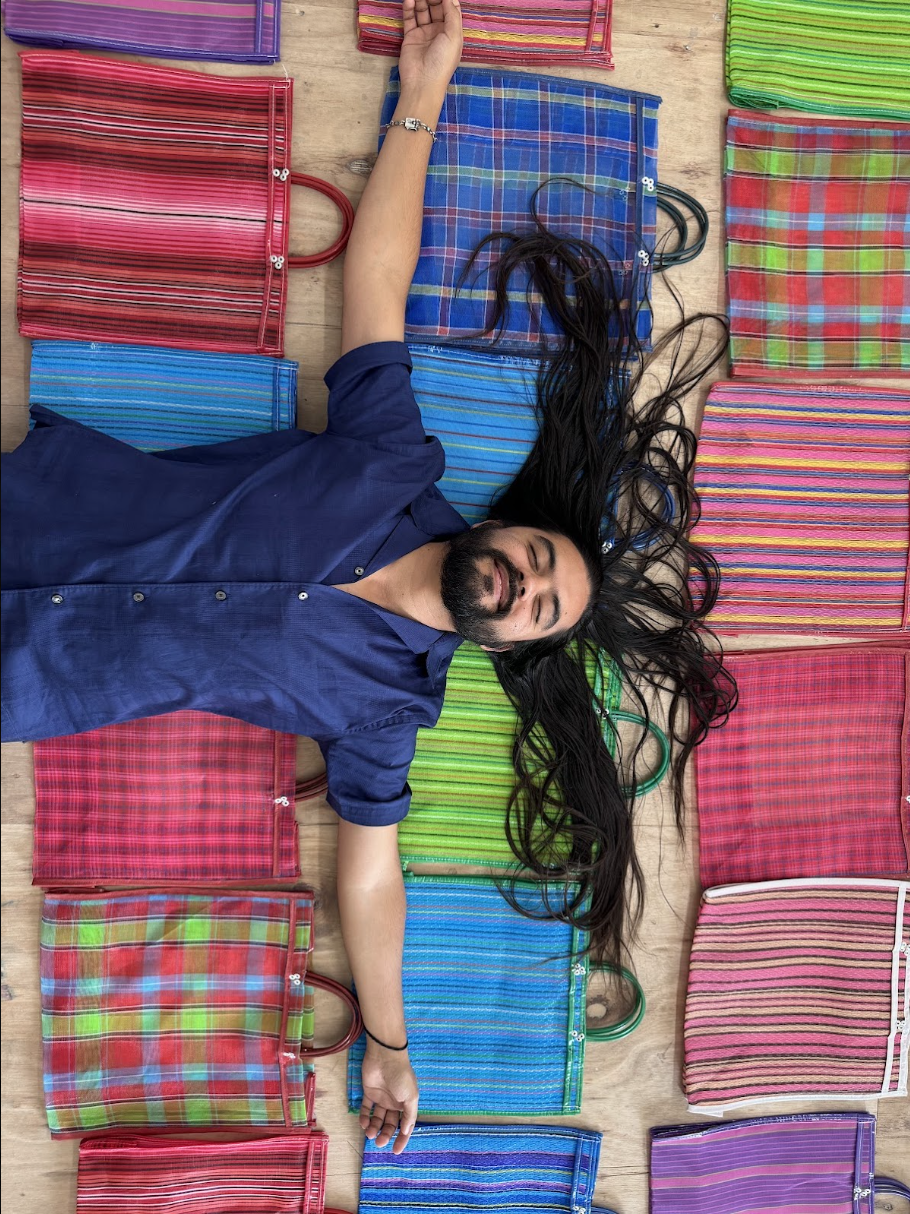
Also present in the studio are the market bags, colorful mesh plastic from his family’s market stall in Mexico, which Oscar has been exploring as a material and concept. Brought to Miami in a suitcase by his grandfather, they carry a direct family connection and a curiosity about movement, impression and what lies in between. He is thinking about hanging configurations, motors that slowly turn them, and the possibility of using heat to mold the plastic into forms that retain the impression of a hand or an object, an idea still finding its shape.
The residency has given Oscar Rieveling something he hadn’t fully had before: a dedicated space where the work can breathe and be laid out on its own. He describes the moment as a lotus blooming after a long period underground momentum finally present after years of quiet gestation that has been really insightful and revealing. Being alongside Loni and Roxana, fellow WaveMaker artists in residence, he says, has been its own kind of gift.
Want to know about upcoming exhibitions, programs, and events? Get Artist eNews with opportunities for artists? Get connected today: sign up for monthly eNews here.
As Miami's leading alternative nonprofit art space, we rely on the support of donors to help make art happen. Thank you for considering a tax-deductible donation today. GIVE NOW.